Things are better than they seem
They say comparison is the thief of joy—that if you want to be happy, stop comparing your life to other people’s. The problem with this advice is that it goes against human psychology. Comparing ourselves to others is what humans do.
We’re not going to be able to stop comparing our lives to other people’s. This is fine, actually. You just have to look at the complete picture.
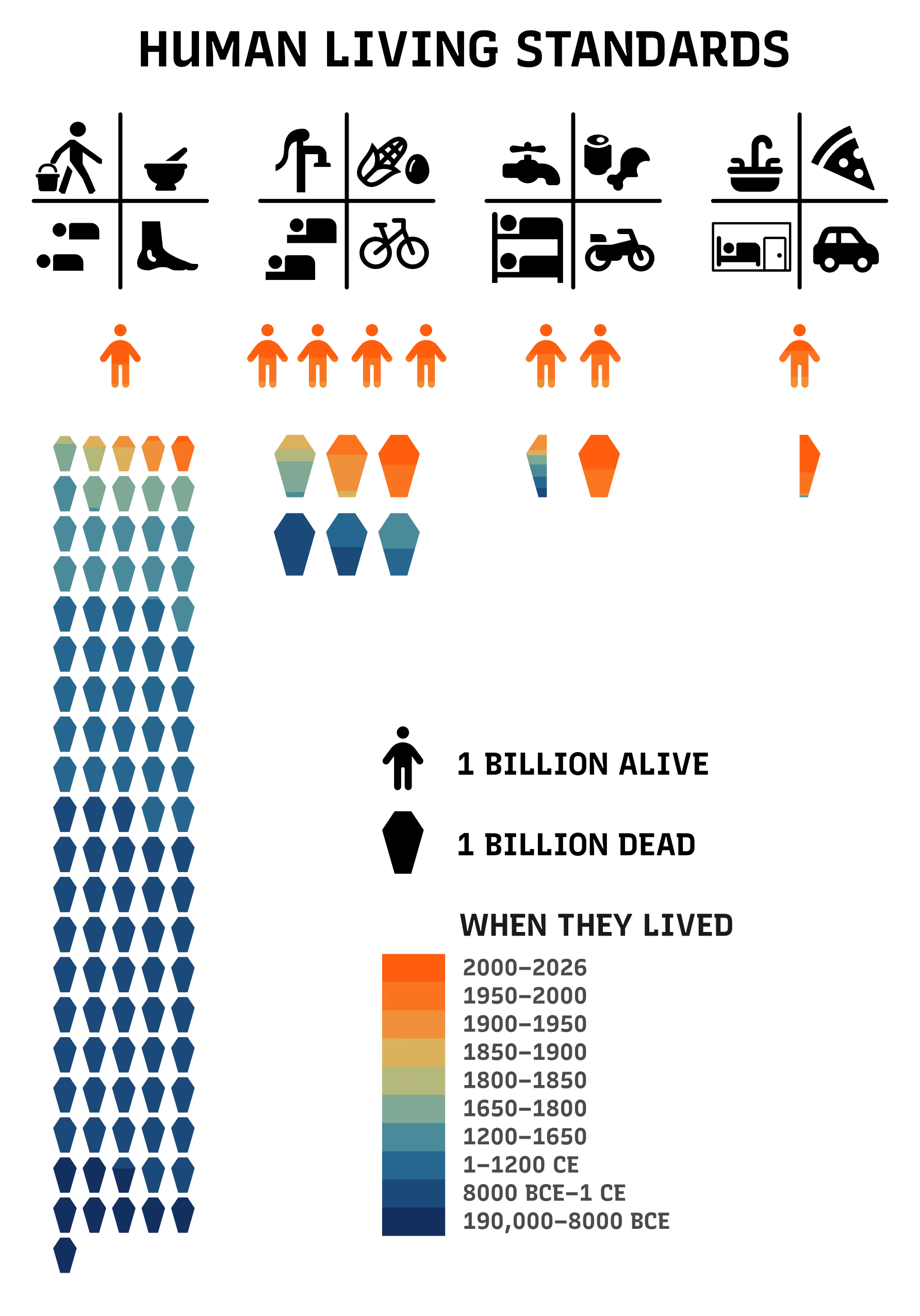
The infographic to the right summarizes the material living circumstances of every human who has ever lived in one chart. (Some rounding will be involved.) Each stick figure or coffin represents one billion people, alive or dead. We divide them into four broad columns.

At level 1, everywhere you travel, you do it on foot. All of the water you use, you (or a family member) must carry from a well or spring, which might be 15-60 minutes of walking from your home, where you sleep on the floor under a rug. Most people at this level grow their own food, which means they usually eat the same thing every meal, often some kind of porridge, and if the crops fail, you starve. 1 billion people live at level 1, including large portions of sub-Saharan Africa.

Life at level 1 is very precarious, so getting to level 2 is a big upgrade—you can start to save money, and hunger is no longer a constant concern. Your village has a water pump so you don’t have to walk long distances to fetch water. You get some variety in your diet by adding vegetables and eggs, and you get a mattress to sleep on. When you need to go into town, you can do so by bicycle, which can carry a little bit of cargo and is a huge upgrade from walking. If someone in your family gets sick, you can buy medicine, although too major an illness risks pushing your family back to level 1. And although it’s not reliable, you will often have electricity, which allows you to work and study after dark. 3 billion people live at level 2, including much of India.

Places that do very well at level 2 may advance to level 3, where you get a cold-water tap in your home. At this level you can buy a refrigerator, which means you can eat meat regularly and keep what you don’t eat for a few days. You get a real bed to sleep on instead of a mattress, although you may need to share a room. And you can get to work on a moped or motorbike instead of using pedal power. At this level you have reliable electricity, and perhaps a television or laptop. 2 billion people live at level 3, including much of China.

Finally, you have level 4. These people have it made: they have hot and cold running water in their home, so they can take hot showers and baths. Their food has endless variety—they get their food from grocery stores that sell more kinds of food than anyone would ever eat. In fact, in some level 4 places, people worry about eating too much instead of too little! People at level 4 get their own bedroom if they want, and they have cars, allowing them to travel great distances in comfort. 1 billion people are at level 4, including most of the United States and western Europe.
In the United States we tend to think of level 4 as the default and the other levels as tragic outliers. That’s wrong. Most of the world is at level 2 or 3. And even that is an innovation. Humanity stopped being majority level 1 only in 1966. That’s within living memory. The Beatles were touring that year. Between 1966 and the dawn of humanity, most people around the world were subsistence farmers who were one bad harvest away from starvation. Go back to 1800 and level 1 is 85% of the population. That’s why the first column of this chart has coffins for 101 billion people: almost everyone throughout human history lived the precarious life of a subsistence farmer.
Those of us who live at level 4 are fantastically lucky. We are cosmic lottery winners to be born in this time and place.
If you have hot and cold running water, your own bedroom, and a car, you’re in the top 13% most fortunate people alive. And on the grand scale of every human ever born, you’re in the top 1.4%.
What, you’re saying everything is fine?
Not at all! We have problems, important ones, and we need to work to fix them!
But a lot of Americans these days are in despair. We hear about our problems all day every day, from traditional media and social media. The frontpage and the algorithm want your attention above all, and the best way to get it is anger and fear. They’re not in the business of informing the public about the large-scale historical trends that current events play out against. That big picture affects your life (and everyone’s lives) a lot more than the daily headlines.
A lot of people today don’t believe the world’s most important problems can be solved. But when you look at the problems we’ve solved already that most people never think about, the picture changes.
I’m still unhappy.
You’re allowed! How to feel is up to you. Money isn’t everything. There are lots of non-money things people need to be happy.
This is worth some thought. If you’re unhappy, is money really the reason? How much money would you need to solve your problem? Is there a way you can reduce the amount of money you need?
 reduce the amount of money you need
Are you unhappy because of national or world events? Then do something about it! Start by watching these two four-minute videos about getting from “this is hopeless, everything sucks” to joining work on a problem. I promise you will feel better helping to fix one of these problems than you will sitting on your couch and doomscrolling.
The one thing you shouldn’t do is despair. If you’re reading this from the US or Europe and you’re not homeless, you are one of the luckiest people in history. Americans and Europeans live our lives surrounded by luxury that we usually don’t notice.
If you let the news or social media tell you how happy to be, you will always be unhappy, regardless of what is happening in the world, because selling anger and fear is their business model. Those feelings are how they keep you coming back.
Ignore the haters. Enjoy what you have. Work to make things better.
Images and research courtesy of Gapminder. See their Income Levels page to explore current global living standards in more detail, or Income Mountains for historical trends. The four-level income framework is from Hans Rosling’s book Factfulness.
Stick figure icon by Font Awesome; other icons by Pinhead, Temaki, TDesign, and Bootstrap Icons.
Comments
No comments yet. Be the first to share your thoughts!
Leave a Comment
Comments are moderated and will appear after approval.